Thoughts on President-elect Donald Trump’s sentencing and the denouement of the defining story of my career:
Finality came with a flicker of a flat screen TV and $375 in court fees.
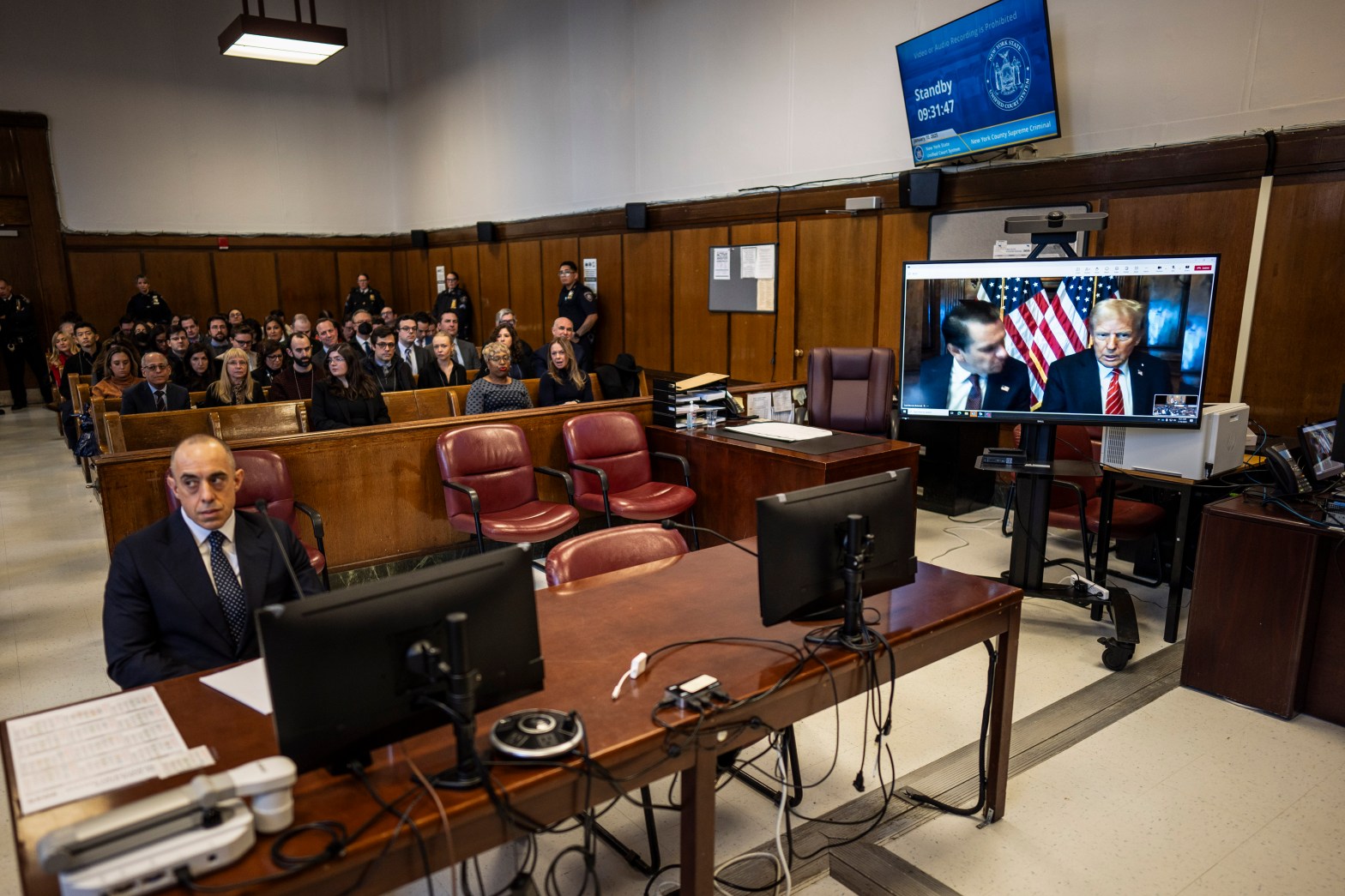
“Godspeed,” the judge said, and the defendant — soon to retake his place as leader of the free world — disappeared from view. A digital kerplunk signaled the end of the Microsoft Teams call tying it all together: a Manhattan courtroom and Mar-a-Lago, the criminal justice system, politics, a singular moment in American history, and the defining story of my career.
President-elect Donald Trump, whose legal travails have consumed my life for much of the last five years, was sentenced Friday for his conviction in what has been termed the “hush money case.”
By the nature of Trump’s re-election in November and his return to the White House next week, Judge Juan M. Merchan said there was nothing he could do to punish him — no prison, no probation, and no fines. Not even a minute of community service.
I watched from the courtroom gallery, pecking play-by-play into my laptop, as Merchan sentenced Trump to what’s known as an unconditional discharge. Up on the screen, Trump pursed his lips and scowled. Up on the bench, the judge – a man Trump once said, “looks like an angel, but is really a devil” – concluded the 33-minute proceeding by wishing him well in his presidency.
The outcome was something of a fait accompli. A week earlier, Merchan had telegraphed his intent not to punish Trump because of the unique legal protections he will be afforded as president, which the judge said made incarceration or other penalties untenable. Afterward, a colleague and I arrived at the same descriptor: Anticlimactic.
Still, it was extraordinary: the first former U.S. president sentenced for a crime; poised to be the first convicted criminal sworn in as president.
Trump’s criminal record will bear a felony conviction unless and until he wins on appeal. He must pay court costs, including $25 to a program assisting crime victims. Like all people convicted in New York, he must also provide a DNA sample for a state crime databank.
Merchan had said it was important to sentence Trump before next Monday’s inauguration to have “finality” on the case.
Finality was important for us reporters, too. Not because we root for a particular result – we don’t – but because stories without endings feel incomplete, like a tie game or a cliffhanger.
We’d been there every step of this unprecedented case.
We shivered outside a court building in early 2023 as Michael Cohen, Hope Hicks and other Trump World figures paraded in to see prosecutors and the grand jury. We watched from a hushed courthouse hallway as his indictment was filed in the darkened clerk’s office just after closing time. We lined up for hours – some overnight – for his arraignment. With no cameras allowed in the courtroom, it was on us to chronicle his seven-week trial for the world, culminating last May in the jury’s verdict: guilty 34 times.
Some of us work for competing news organizations, but many of us are friends – our bonds strengthened by the shared experiences of early mornings, long nights, logistical hurdles, security sweeps and occasionally spotty internet. We’ve commiserated over pints, and celebrated birthdays. We’ve lamented canceled dates, a missed anniversary and all the skipped trips to the gym in the name of journalism. Away from court, life went on: Engagements and weddings; children born or on their way; love and loss.
We needed to see this story — our story — end.
But whether Trump’s sentencing would even happen was in doubt until the night before, when the U.S. Supreme Court became the fourth and final court to reject his bid for a delay. A colleague alerted our text chain to the ruling just as I was breaking away to distract myself with a college football playoff game. Moments later, at 7:12 p.m., the email arrived from the high-court’s press office: by a 5-4 decision, sentencing was on.
By my best count, I’ve reported on at least 350 stories about Trump in the last five years and written his name in them no less than 10,347 times. I’ve doubled as a TV correspondent for The Associated Press’ broadcast unit and appeared as a guest on cable networks, streaming services and radio stations as far away as Australia and New Zealand.
Like other Trump legal beat reporters, I’ve spent hours on the phone with lawyers, court officials, experts and sources, and I’ve lapsed into the obsessive rhythms of refreshing court dockets for new filings. I’ve thought about Trump, his trials and legal maneuvers whether on the clock, or far off of it, compelled by the paranoia of missing a development.
It has been a grind, and the privilege of a lifetime to be part of the AP team covering this monumental case.
As Trump’s sentencing was wrapping up Friday, I looked around the courtroom – the same, expansive, austere space where he was tried and convicted, with wood-paneling and white walls, church-like pews, and the words “In God We Trust” plastered above the judge’s bench. I saw familiar faces – dozens of reporters and a few members of the public who came back to witness the end for themselves.
I thought back to the indelible moments: Trump glaring at District Attorney Alvin Bragg at his arraignment; Trump cursing under his breath as Stormy Daniels testified; Trump winking at me as I studied his exit one day; furiously typing the verdict to colleagues in a Slack channel; Trump’s son, Eric, putting a hand on his back afterward; and, now, the sentence and the finality of it all.
I thought about the other high-profile cases I’ve covered – watching Harvey Weinstein hauled from the same courtroom in handcuffs upon his 2020 conviction and seeing Bill Cosby scream at a prosecutor in suburban Philadelphia in 2018 after his. (Both have since been overturned on appeal).
And then I thought: What’s next?
Friday night, as has become ritual, I met friends from the beat for one last round of drinks – to toast the end of this phase of Trump’s legal saga, and all that we’d been through. On the train home, my mind wandered to other cases slated for trial soon – New York City Mayor Eric Adams, Sean “Diddy” Combs, Luigi Mangione, Steve Bannon and Weinstein, again.
Trump’s legal fight will continue, assuredly, but this was the last time we will see him in this setting — even if he was on a TV screen. Reflecting now, I return to Merchan’s parting words to Trump: “Sir, I wish you Godspeed as you assume your second term in office.”
Godspeed to us all.
Michael Sisak is a law enforcement and courts reporter for The Associated Press in New York City. Follow him on X/Twitter and Bluesky and see more of his work on AP News.
Photo: President-elect Donald Trump’s lawyer Emil Bove listens as attorney Todd Blanche and Trump appear virtually for Trump’s sentencing in his hush money case on Friday, Jan. 10, 2025. (Jabin Botsford/The Washington Post via AP, Pool)
 Michael Sisak